A Special Economic Zone built on the site of a shuttered textile mill, explicitly to re-employ the workers that closure displaced, has been de-notified down from 38 hectares to under 5 — an 87% shrinkage over 19 years, most of it in the last two.
Industrial Land · SEZ Policy · Textiles · Gujarat
A Textile SEZ Built to Re-Employ Mill Workers Has Shrunk 87% Since 2007
Revised
· v1.0.0 · what changed
On 31 August 2026, the Ministry of Commerce and Industry de-notified another 5.6 hectares from the GIDC Apparel Park Special Economic Zone in Khokhra, Ahmedabad. On its own, that is a routine administrative order — the kind of notification that runs a few hundred words and gets no coverage. Read against the SEZ's own history, it is something else: this zone has now shed 87% of the land it started with in 2007, and it was built, quite explicitly, to re-employ the workers a textile mill's closure had put out of work.
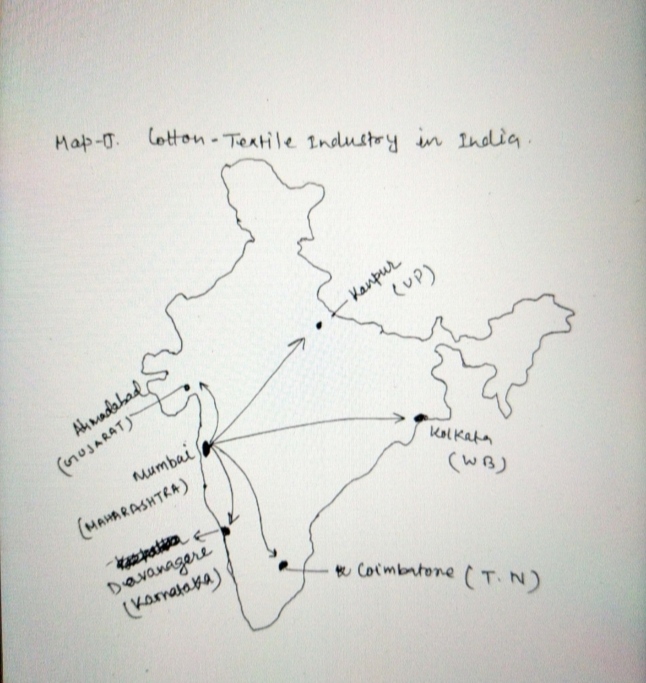
Land freed by one mill closure, meant to employ its workers
The Apparel Park was proposed on roughly 38 hectares that had belonged to the erstwhile Ambika Mills, a textile mill in Ahmedabad. The project was conceived specifically to give displaced mill workers somewhere to go: a garment-manufacturing SEZ replacing the industry that had just failed on the same ground. It did not move quickly. The scheme drew a legal dispute over the land in the Gujarat High Court and separate delays from the Finance Ministry and the Environment Ministry, and the zone did not become operational until 2013 — six years after its 2007 notification. Once running, its units were 100% export-oriented, manufacturing garments (jeans, menswear, womenswear, kidswear, hosiery) for outbound sale, the standard SEZ model.
The area, notification by notification
| Date | Notification | Change | Resultant area |
|---|---|---|---|
| 2007 | S.O. 543(E) | Originally notified | 38.043 ha |
| 28 Aug 2024 | S.O. 3639(E) | De-notified 17.6264 ha | ~20.45 ha |
| 31 Aug 2026 | S.O. 4849(E) | De-notified 5.59989 ha | ~4.82 ha |
Both de-notifications came at the request of the Gujarat Industrial Development Corporation (GIDC), the state body that developed the zone, with the state government's approval and a recommendation from the Development Commissioner of the Kandla SEZ. The stated justification in the notification itself is that the released land "would be utilized towards the creation of infrastructure which would sub-serve the objective of the SEZ as originally envisaged" — language that reads, on a zone that has lost seven-eighths of its land, less like expansion planning and more like a formal sign-off on contraction that had already happened on the ground.
Not an isolated case
SEZ de-notification is a recognisable pattern nationally, not a one-off. The income-tax exemption that made SEZ status valuable to developers and unit-holders carried a sunset clause: developer benefits under Section 10AA lapsed from April 2017, and unit-holder benefits from April 2020 (extended to September 2020 because of the pandemic). A wave of de-notifications has followed in the years since, across sectors and states — a single recent batch of notifications, unrelated to this one, de-notified 22.767 hectares combined across an IT SEZ in Greater Noida, a solar-panel SEZ in Kerala, and an IT/ITES SEZ in Telangana. An older Comptroller and Auditor General review of a sample of 50 approved SEZs, published in 2014 and describing that period rather than today, found only 15 operational, 29 yet to start any commercial activity, and 6 already de-notified — a snapshot from over a decade ago, but the direction of travel it describes has not obviously reversed.
The net read
A zone conceived to replace one failed textile enterprise with another, on the same ground, is now itself down to a fraction of its founding footprint — and the mechanism doing the shrinking is not a dramatic closure but two quiet, procedurally unremarkable notifications, three years apart, each one smaller than the last de-notification that preceded it. That is usually what SEZ contraction actually looks like: not a single failure announced at once, but a series of routine paperwork entries that only add up to something notable when read together.
Sources: OCR transcript of the notification's own text (S.O. 4849(E), Ministry of Commerce and Industry – SEZ Division, dated 31 August 2026, including its own recital of the 2007 and 2024 notification numbers, dates and areas), via NakliTechie/sansadsaar-gazettes' GitHub-hosted index of archive.org's Gazette of India OCR corpus. The Apparel Park's origin on former Ambika Mills land, the Gujarat High Court dispute, the Finance/Environment Ministry delays and the 2013 operational start, plus its export-oriented garment-manufacturing focus, are from Fibre2Fashion's contemporaneous trade coverage and related industry sources, not independently verified against a government release. The SEZ income-tax sunset-clause dates and the unrelated 22.767-hectare de-notification batch (Ansal IT City, Carborundum Universal, Phoenix Living Spaces) are from trade and tax-advisory coverage found via search. The 2014 CAG figures on the 50-SEZ sample are from that report as summarised in subsequent coverage; they describe that period specifically, not the present state of India's SEZ programme.
- v1.0.0 — 15 September 2026 — first published.
About this article: Researched, written and edited by Umashankar Triplicane Dwarakanathan, with AI research assistance; every figure is meant to trace to the primary source cited. See the Editorial Policy for how sourcing, AI use and corrections work.
