Investors and the CEO: what each side is looking for
Investor cares about the Top Line (Revenue) and the bottom line (CAC; LTV; Profits if any)
Together they define the fate of the product, its cost of capital, and valuation.
The relationship between an investor and your company's CEO can be seen as the relationship between Tom and Jerry. Although they often fight, they always get together at the end and turn up for the next episode.
Trust and Respect
All jokes aside, the relationship between the investors and the CEO is driven by an ability to have mutual best interest, validated by trust and respect in their own domains.
Need for Valuation leads a CEO to return to the investors with a User base, representing certain cash flow, an estimate of the growth potential given the risks to be undertaken, and finally, capital estimates of funding required to run the business. In a pre IPO stage startup, starting from the valley of death where bootstrapping and Jugaad are the modus operandi, once the business shows signs of breaking even, investment pours in through a series of investment rounds (seed, A, B, C...). If customers want it, an IPO, the market makes the decision along with promoters.
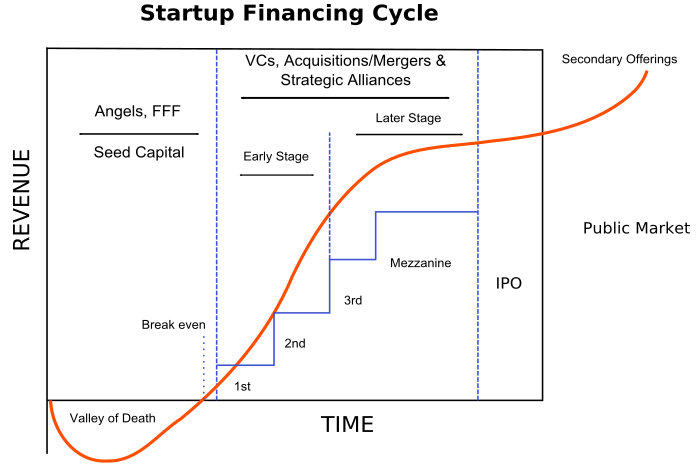
The startup financing cycle — from seed capital, through the valley of death, to an IPO. Source: Kmuehmel, Wikimedia Commons, CC BY-SA 3.0.
On the other hand, an investor plays a key role in vetting early-stage startups based on their risk versus reward; an Angel investor is effectively a fairy godmother who believes in the CEO's vision and enables them to succeed. As a result of this trust, an investor owns a product/company portfolio representing a risk profile suitable for hedging against market assets to create the most efficient frontier for market players.
Read more about an efficient frontier https://www.investopedia.com/terms/e/efficientfrontier.asp
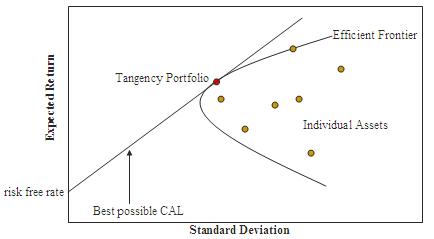
The Markowitz efficient frontier: expected return against risk, with individual assets sitting inside the curve. Source: User:G2010a, Wikimedia Commons, public domain.
Product Potato: a case study
Imagine a successful potato farmer from a rural town trying to make it in the big city.
The potato farmer has a local consumer base who buy potatoes frequently from the farmer.
The farmer has repeated feedback from the consumers that the french fries made from his potatoes are so addictive that nobody can stop eating them!
One consumer was quoted saying, 'I really like your potatoes, they make amazing french fries, but somedays, I come back from home very tired and want to quickly make french fries without the hassle of cutting them.'
One fine morning, when taking a shower, the farmer has an epiphany; he says loudly to himself, 'Why to sell only potatoes?'
'Why not sell frozen french fries made from the farm's potatoes.'
The farmer thinks this new product will address the spoken need for french fries and the unspoken need for convenience by adding a new feature, pre-processed potatoes availability as ready to cook.
The farmer tests the idea by cutting potatoes evenly, storing them in his fridge overnight, and trying to sell them to the consumers who come the next day; he particularly targets the one guy who expressed his love for french fries while being lazy about cutting potatoes. This experiment is wildly successful; the potato farmer has filled his fridge with frozen ready to cook french fries, while his customer always asks for more.
In some ways, one can summarize this to what a locally successful potato farmer and ready-to-cook french fries entrepreneur faces when they want to enter a wholesale market to sell an existing potato consumer base and the market potential of ready-to-cook french fries to a trader with experience in selling potatoes and french fries globally.
The local farmer (CEO) has a stock of potatoes and consumers who already buy potatoes from him/her but have recently shown interest in french fries. The French fry business is booming, which he/she estimates will be valuable to the trader. The farmer plans to sell french fries (new service) and potatoes (existing service) to the consumer (who finds ready to cook french fries convenient).
However, the trader (Investor) at the market has an idea of the risks in the global potato products category, what types of potatoes /ready to cook french fries are already selling, and what the whole potato market looks like to consumers (who love french fries) and potato price speculators, commodity traders and regulators.
A local potato farmer can give detailed presentations and pitch about how good his/her supply chain of potatoes is, his/her estimate of potato harvest next season, the cost of growing potatoes, and the growth rate among his/her local set of consumers who value ready-to-cook french fries.
A farmer bears the risk of growing potatoes and growing local consumer base for ready-to-cook french fries.
A trader can ask in length about the guarantee of quality, volume, and price of potatoes. A trader bears the risk of running a potato market. A trader may urge the farmer who is having some success.
In large companies, many of these roles are taken by internal stakeholders, such as a decision board acting as investors in new business ideas and innovative managers pitching internally. It is easier said than done, requires entering a lot of elevators to pitch, dealing with red-tape, and the stress leads to early baldness in some cases.
In start-up terms, a potato is grown by a tech team sitting next to you! A question still remains.
Can you sell french fries (Voice of the consumer)?
This leads us to the next section on understanding Voice of the consumer (VOC)
Voice of the consumer (VOC)
A typical user story
A user looking for convenience has found your platform suitable and would like to raise an event.
This is the voice of the customer (VOC). To many, it may seem overly simplified, lacking, or even a gross underestimated generalization from the reality of the VOC.
In any case, describe it however you want, the VOC in the technocrat's age is fast evolving from Vox Populi (Voice of people) to vox Dei per fidem (voice of God through faith)
Leaders in the industry often claim - The customer is always hungry for more...
And they are right; however, should we give the person fish or teach them to fish?
Talk of customer-driven, customer-centric, and customer obsessive design lack in one aspect.
Lack of Customer education
With a large number of services, the customer is tired of you; you are tired of looking at them and how they would use your services, indicating that it is a time to reflect and change. As a business, what have you learned from the users, what do your users want to learn from you, and how do we educate them to avoid dropouts and create literacy about your product offerings?
This is not bad; boredom and idle time have helped people realize higher goals, like writing a blog post.
But only with abstraction and taking a step back to observe the puzzle does one find the jigsaw puzzle's missing piece.
But beware technocrats; there is still a business that needs to be run. And a good business runs on a strategy based on risk, reward, and cost to implement the planned change and deal with unforeseen circumstances.
How can a start-up address the VOC and also ensure it can stand on its own two legs?
What can help with the early concept strategies of the product? Maybe a product strategy?
As with any business, the process and the outcome are often jumbled and need clear separation.
As experts in human psychology, a friend in the HR team once said, write things as what Challenge was faced, what Action was taken, the Result, and what Tech have you used and learned about (CART) help you with job applications and building good products. (CART is an informal mnemonic shared in conversation, not a published methodology.)
To recap
VOC: voice of the customer
The CART framework
The article below is an outcome of time spent trying to figure out where Information technology is from the perspective of a hardware engineer who has had the luck of stumbling upon it recently.
I have never had the knack for marketing, and to be honest, I don't understand SEO so well.
However, assuming that we have the customer's voice and understanding what the user wants, what do we do? Let's hire a manager, a product manager - the ears to the VOC.
Product manager
A product manager conveys an interpretation of the voice of the customer to the team that will build it and scale the solution
To achieve this, there are many tools a product manager has in their kitty; a useful link would be the course from Cole Mercer and Evan Kimbrell, who do a great job of explaining the who's who and what's what of product management.
NO - is more pronounced in the product manager's vocabulary, rather than Yes, but why?
Being prudent not to over-interpret VOC and paying heed to the voice of the tech executives (VOTE) who have to build the right product for the market (as a reply to VOC) and to also build the product right to enable fundamental innovation (reply to VOTE)
To summarize, the product is the center of gravity when viewing tech as a business (TAB). Product managers are the astronomers (Kepler) trying to predict when the User comets could come and how best we can put together a solution to create convenience for users in their journey through the ecosystem you have created.
Related on this blog: Indian IT in an AI Era · AI Tools Edition 03: A Repo With 98,000 Stars This Tracker Had Never Heard Of — two more pieces on this blog's technology and AI-tooling coverage.
About this article: Researched, written and edited by Umashankar Triplicane Dwarakanathan, with AI research assistance; every figure is meant to trace to the primary source cited. See the Editorial Policy for how sourcing, AI use and corrections work.
